Keedy, Hugh Forrest
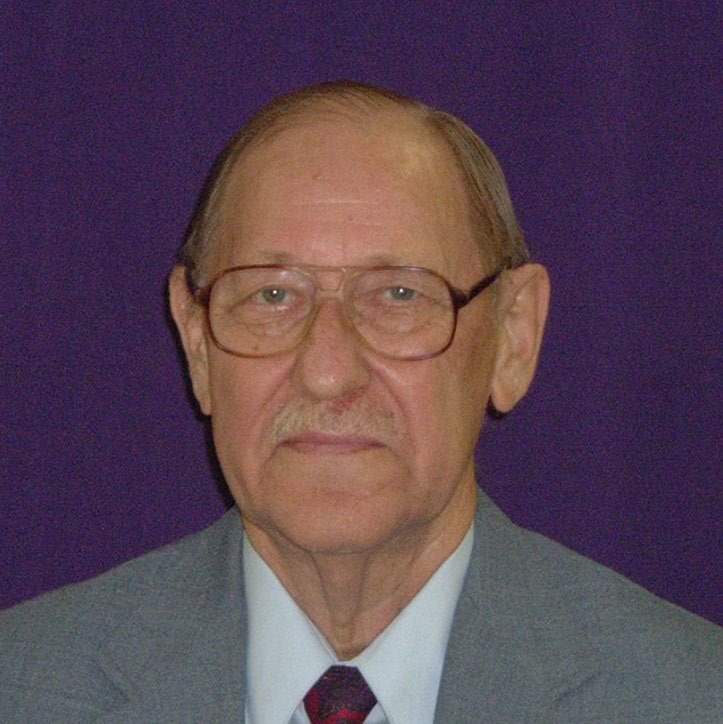
Eulogy for Hugh Forrest Keedy by Jerry Collins
Shakespeare had Marc Antony say of Julius Caesar in his ironic eulogy: “The evil that men do lives after them, / The good is oft interred with their bones.” I am here at the family’s request to witness to the enduring good that lives after Hugh F. Keedy.
I knew Hugh as a member of the applied mathematics faculty when I entered the School of Engineering as a freshman in the fall of 1958, and later as a colleague when I moved to the Vanderbilt research faculty in 1977.
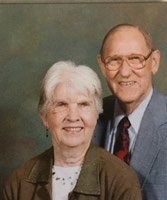
When he retired from Vanderbilt in 1990, Hugh and Marge continued to live in Nashville for a time, then moved to a house on 53 acres of property in the Bethesda community in southeast Williamson County. Hugh developed the Bethesda Museum, for which he received community awards, and taught computer and other classes in the community.
Hugh wrote an autobiographical sketch as a member of the Bethesda community that is on the Web: He was born in eastern West Virginia in 1926 to parents who struggled on small farms and moved from place to place. They moved to Baltimore in 1938 and Hugh’s father took a job in a steel mill. Hugh was in the 7th grade then and had already been in 11 schools. His parents lived in their Baltimore row house until the 1980s, when they both entered nursing homes.
When Hugh graduated from high school, World War II was in progress and Hugh entered Surgical Technical School in the Army. By the time he was trained, the war was over and he helped dismantle a hospital in Egypt, then returned to the US and was discharged on August 22, 1946. He enrolled at what is now Lipscomb University in January 1947, where he met Marge. On August 22, 1947 he began work as a draftsman in Baltimore. On August 22, 1948, he and Marge were married. She had taught school in Baltimore during the previous year. He entered Peabody in fall 1948 and completed his undergraduate work in two years under the GI Bill. Economics was difficult. On occasions Hugh and Marge would walk to the corner grocery and decide what they could buy for supper for 25 or 50 cents.
By summer 1951, Hugh had finished his undergraduate work and some graduate work, but his GI bill was running out. Outside a class one day, he was recruited to teach engineering
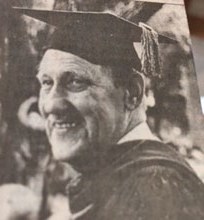
mathematics by the then-chair of the mathematics department, who I believe was Dr. Walter Graham. Vanderbilt had heard about his academic work at Peabody and his drafting experience. Hugh began teaching engineering math classes in the fall of 1951 and remained a faculty member until my retirement on the last day of December 1989, a period of thirty-eight and one-half years.
On his retirement, Hugh’s achievements at Vanderbilt were summarized by Department Chair Ed Thackston and Associate Dean Ed White in a memo they wrote in support of his emeritus status. They stated that his primary focus throughout his career was on educational objectives and methods. He served on numerous departmental and School of Engineering committees, but his enduring special interest was in freshmen. In 1970 he was appointed Chair of the Committee on the Freshman Year in Engineering. Over the next several years, Hugh developed two new courses and several innovative approaches for freshman, resulting in his being awarded in 1977 the Western Electric Award for Excellence in Engineering Instruction by the Southeastern Section of the American Society for Engineering Education. His interest in teaching and learning led to the development of two new communications courses and studies of teaching and learning methods which were presented at several national conferences. He identified computer-aided design, or CAD, as an important learning tool and incorporated two- dimensional and three-dimensional CAD into courses that were among the first in the nation of their kind and led to further national recognition. He also had an interest in minority students, administering the school’s pre-engineering minority program for four years. He and Marge have treasured their School of Engineering relationships and made a practice of attending open houses and school celebrations as they occurred.
Sandra and I came to know the Keedys as friends when we moved to Nashville in 1977 and became members of the Otter Creek fellowship. Sandra and I identified them as parenting role models, along with the John Ruckers, the Frank Madduxes, the Buddy Arnolds, and several other families. The Keedys were the people we gravitated to at church retreats (they were usually in the kitchen, Sandra’s favorite place).
Hugh has always had a droll sense of humor. At the foot of his property in Bethesda, he had a sign posted “WEEDS. Free. Pick your own.” He was especially proud of the 60-some varieties of peppers he grew. He loved spoofs of church members and wrote several, used at teachers’ banquets and other occasions. I still remember the More Rovin’ Hymnal.
Hugh learned to sing in hymnals with shaped notes. One year at an inner-city ministry retreat in Texas (which would help give rise later to our Wayne Reed Christian Childcare Center project downtown), he called me over excitedly to a publisher’s exhibit that featured a contemporary Christian songbook…done in shaped notes. The last time I saw Hugh was when Doug and Nan Smith and Sandra and I took hymnals with shaped notes out to Bethesda to sing with Hugh and Marge.
Hugh had an outstanding gift for organization. When he became chair of the deacons’ committee at Otter Creek, the meetings began to run on time and on agenda. At some point in our old building, Hugh was asked or took it upon himself to ring the hall buzzer signifying the end of class. It was logical that a man who measured his career in 50- minute class intervals should do this. He rang the bell faithfully for years. No matter how interesting the class discussion was, you would hear Hugh’s bell and it was time to go. He would also time worship intervals, keeping notes of what minute the preaching would start and when it would stop.
Perhaps the best thing I can do to give the flavor of Hugh’s and Marge’s remarkable life together at Otter Creek is to share with you some excerpts Sandra wrote on the occasion of Hugh’s eightieth birthday celebration.
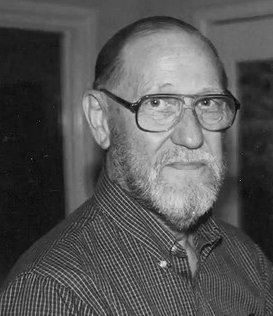
Sandra Collins’s letter to the Keedys on their eightieth birthdays (2006)
We were surprised to receive an invitation to your eightieth birthday bash, not because we hadn’t thought we would be included but because the two of you were eighty. No one in our whole family could believe it. Jerry said, “Surely that’s forty apiece.” Reid, who as a child referred to you once as Marge and Kew Heedy, was more surprised than anyone else. “I thought they were your age,” he told me. I knew you were older but I thought by only a year or two. After all, Reid’s four-year-old son Isaac, who is pretty perceptive, refers to Marge as “Mrs. Cutie.”
Over the years of upheaval and storm at Otter Creek, which probably have a regular cycle though I’m more familiar with the storms than the calm, various people have said, “Well, I am going to leave. I cannot….” My response has repeatedly been, “How could I leave Marge and Hugh and…?” I’d name a long list of other Otter Creek pillars (whom I prefer to call “treasures”). “These are the people who taught me how to live, how to serve, how to rear my children. How can I leave them?” Among my great memories are these:
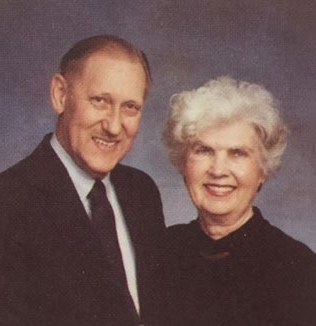
1. the two of you dragging in all the groceries at retreat sites and, with the help of other old faithful folks, like John and Frank, prepare great meals for scores of people oblivious to all the work it took; 2. Hugh’s designing a scramble plan for potlucks; 3. beautiful flower arrangements on the ledge of the baptistery; 4. your organizing craft fairs for YES, WRCCC, and the seniors at Bethesda; 5. seeing all the beautiful crafts you both had made (I have a pillow, an apple apron, a towel, NOEL on wood blocks, wooden houses, a pine cone angel, twelve beautiful place mats, and who knows how many other things your hands designed. I was surprised only a little when I discovered you had helped organize senior craft fairs at Bethesda.); 6. Hugh’s writing out a diagram of the first sentence in Ephesians (a marvel indeed); 7. hearing the story of how you took in two young boys when their mother died (I still cry when I think about it; 8..having you, Marge, challenge some of my Biblical interpretations (I don’t always change my mind, but you make me rethink); 9. Marge, Joyce Rucker, and someone else performing in a faculty talent show; 10. seeing for the first time the house you had designed and built, enjoying your enjoyment of every feature, marveling at the handiwork whether a wooden table or a tile floor, or paintings, or flowers or tomatoes or peppers (I am eager to see the next dwelling.); 11. taking the amazing tour of the museum Hugh put together for Bethesda, realizing how much time and thought had gone into it, thinking what a gift to the community and to us to see all these relics of our lives, hearing Hugh’s specific knowledge about every piece; 12. watching each of you with little children (It is no wonder your children and your grandchildren thrive and have moved out into all kinds of wonderful directions. You take obvious and genuine pleasure in them and offer so much encouragement. I had always thought of Hugh as retiring and reticent until I saw his delight in young children. I love hearing of each new adventure of the grandchildren.); 13. watching Marge prepare for teacher appreciation dinners, wedding receptions, and a variety of other large gatherings with seemingly no panic or frustration, improvising, delegating, and enjoying the people gathered around; 14. having the two of you help with Reid’s great rehearsal dinner, which we all still enjoy thinking about (your
remaining cheerful despite the non-working dishwasher and all the aftermath of clean up), getting to use my bulletin article about it so many times in so many talks that people come up and mention it to me; 15. being a part of helping us when Erin’s wedding was over (you had volunteered your help earlier but I had wanted you simply to be an honored guest); 16. entangling you into the cookbook production (People still love it and refer to it.); 17. knowing that Marge’s contribution to both Guatemala and especially Kenya would be an amazing one (The products are proof of what the Kenyans learned.); 18. Hugh’s witty words for a newspaper column and a poem about Jerry which hangs to my left as I type this; 19. relentless good humor; 20. Jerry’s inviting all sorts of extra people to what was supposed to be a simple, surprise party for me and your handling the crowd after you and others had worked so hard all day on a house tour; 21. Marge’s comment that I was prone to thinking of great ideas that other people had to follow up on (I refuse to repent of that.). What I have admired most about you both would include these things in no special order:
1. I admire your willingness to grow, change, travel, move. I felt sorry for you at first when you went to California, then learned that you had quickly won over a whole congregation by your servant ways and added a list of very good friends to your already long list. The spectacular quilt spoke volumes about what you had meant to that church. 2. Once you make friends, they are your friends forever; you keep in touch. I have friends everywhere we have lived; I have friends who have moved away from Otter Creek but I am not close to them now. You keep up the friendship, maintain the contacts, know what is happening in their lives. I do not have a word for that kind of commitment. It is rare and precious. You kept up with Tink; you keep in contact with the Hynes, for two quick examples. I have done neither. You continue your relationship with the Vanderbilt faculty and their wives.
3. You take interest in and support each generation of Otter Creekers, not just in mentoring as you did with Kristen, but also with the young couples that meet with our life group. You stay in contact with them in a way the rest of us do not.
4. No one ever realizes how much you do because as true servants, you are modest and humble people.
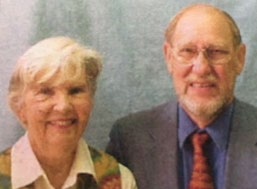
That two such different people have been able to remain happily committed to each other, accomplish so much, affect so many lives so dramatically, and maintain a cheerful, hopeful look at the future is indeed a model for the rest of us. And if all the other “treasures” of Otter Creek ever leave, I will still remain because of the two of you.
Thank you so much for including us in your birthday celebration. Again, I was surprised but not surprised to learn Marge had cooked the meal. Jerry had said as we drew near the table, “It looks like a Marge meal: interesting food that looks delicious.” Please let your children know that we felt honored to be in the presence of such a great extended family.
(Jerry) In the words of Henry van Dyke, “With such a comrade, such a friend,/I fain would walk till journey's end, Through summer sunshine, winter rain,/And then? - Farewell, we shall meet again!”
I sense that someone is moving to ring the bell or would like to. Hugh, you have let us know for years that there is just no time. Stop looking for the bell. You are in a place where there is just no time.
Arrivals, by Marilyn Switzer
In an earlier post entitled "Schedules," I wrote about my friend who said that learning of his terminal disease
was like being at the train station, waiting for the train, with no schedule. Yesterday morning, very early, his
train arrived. For those who loved him, his train was running ahead of schedule. I believe he considered the
train to be right on time. He was a man of many talents. He was extremely intelligent. He used information in
his job that was and is way over my head. He gardened, and that is quite the understatement. He cooked. He
worked tirelessly in his community library. He loved to travel. He loved learning. Even after he was confined
to his home, he kept his mind busy using his computer, often sending me items of interest to pass along to the
senior citizens of our church family. He was a man who did not do things in a mediocre way.
He was a husband. He was a dad. He was a granddad. He was a friend. He was a most useful citizen. He was
a leader in our church. He told a great story when we visited with him a couple weeks ago. He served in the
eldership at church for about 8 years. During that time two different preachers were let go. This was before
everyone had cell phones. When it became evident that the first fellow needed to move on, the eldership
wanted to be sure everyone agreed. My friend was in Hawaii. They tracked him down. The second time, he
was in Alaska. Once again, they were able to track him down to get his input. His opinion mattered. One time
he told me to shut up in a board meeting. I admit that I was stunned into silence. I am certain that it was
"advice" that I desperately needed to hear. In my youthful and "infallible wisdom," I was spouting my opinion
about something of which I knew very little. It stung a little at the time, but shortly afterwards, I realized that
he gave me a wonderful gift in reminding me that a few words go a long way, and that I really don't know
everything.
I am happy for him, that he is no longer waiting for that train. I am sorry that I did not spend more time in his
presence these past months of his life. He became ill at about the time I had back surgery, and I sort of let life
become all about me during my recovery. I am grateful for the time I was able to spend with him and other
friends that Wednesday evening. I will miss him. As another friend, who served with him, said, it is another
loss from that era of our church family. I have no idea what happens when one leaves this part of his or
her journey through eternity, but I like to think there is a joyful reunion going on with Carolyn and Frank and
Ruth and Zona and Charlie and Helen and Howard and Gussie and Buddy and Big John and Kennedy and
Willene among others, as they welcome Hugh. So, while Hugh will be greatly missed, we are confident in the
safety of his travels, for we know the engineer of his train. For us all, I wish joy in the wait at the station and
blessings.